

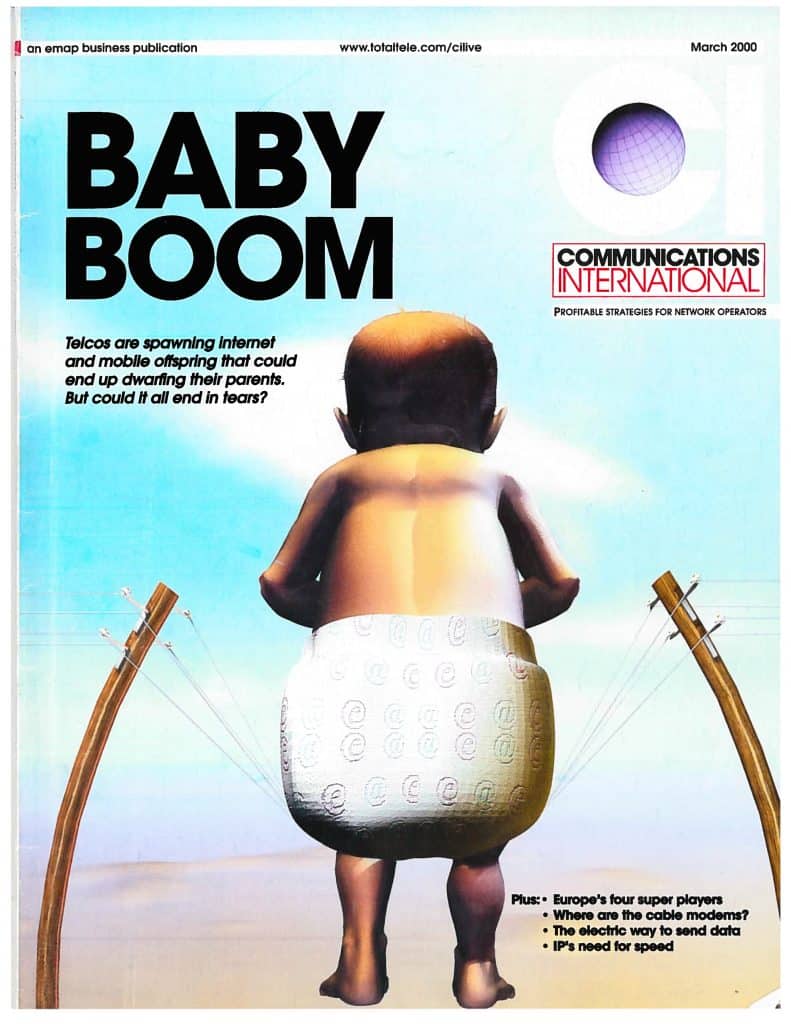
In 2000, the European communications industry was all abuzz about the impending launch of broadband internet access and the holy grail of mobile data through the licensing of radio spectrum for Third Generation (3G) services: (which added data capabilities to the voice and SMS world that was 2G). These auctions were to see record- and bank-breaking bid prices while the talk was all about the mini-computers that 3G-enabled mobile phones would become, connecting to the Internet any time, anywhere.
In March, the NASDAQ hit its peak for the dotcoms and the telecoms bubble. The telephony industry was worried about how to stem its losses from changed behaviour – people were increasingly communicating via data networks (using Instant Messaging – IM) or via personal mobile phones.
Companies were imagining a unified inbox where text, voice, and video messages could be collated. This, 20 years later, is Whatsapp: a single app where all types of communication, including attachments, can be sent, and received.
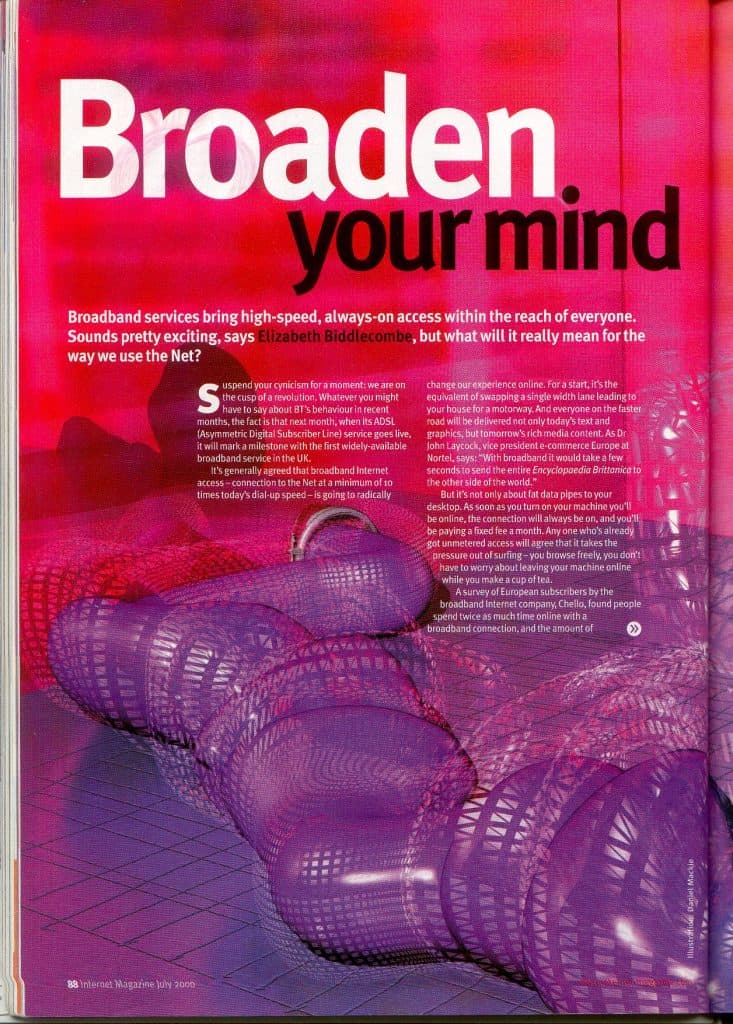
As the Internet was about to explode with the roll out of broadband, most of us were still listening to the whistle of dial-up as we went online. I took an educated guess when writing the article below for consumer mag Internet Magazine. It was beyond my worldview to imagine a future where networks, server processing speeds and distributed computing supported instantaneous transactions, map lookups, payment fulfilments, and hosted media or document editing: the developments that facilitated the first major developments of the 21st century such as Uber, Airbnb and cloud-based productivity/creation software like Google Docs or Canva.
At that stage, peer-to-peer communications was the latest thing: IM was established, Skype was getting set up and Napster had fundamentally shaken the music industry by enabling the free sharing of music files via mp3, which was reaching critical mass due to the introduction of portable mp3 players a few years earlier. Meanwhile, Microsoft had just received an adverse ruling of abuse of monopoly position for bundling in its browser with Windows, after having flattened its smaller rival browser from Netscape.
I increasingly found myself writing about the future of mobile content, banking on a mobile phone etc. All eyes were on Japanese mobile operator NTT Docomo, which was leading the way with its i-mode mobile data service which had launched in 1999.
But no one really knew how much having an always-connected, multimedia device would change life, though they did know what the devices themselves would be like. I went on a press trip to Nokia’s research lab in May 2000 where they presented what was essentially an iPhone–a device where you could create and send your own media and replay music and videos–all new ideas at the time. Again, while we were shown mock-ups of what user-generated content was, it was hard to really know what was meant. That said, reality TV had recently been borne as the genre we know it to be today, so the idea of ‘everyday people’ being the stars had started to take hold.
That it wasn’t Nokia’s device that became the market leader was yet another example in the history of technology where having the know-how isn’t always enough.