Pumping out all those freelance articles bought my ticket and by 2001 I was ready to move to San Francisco. Emap put me on a retainer to be their US editor, so I continued to write for their telecoms titles.
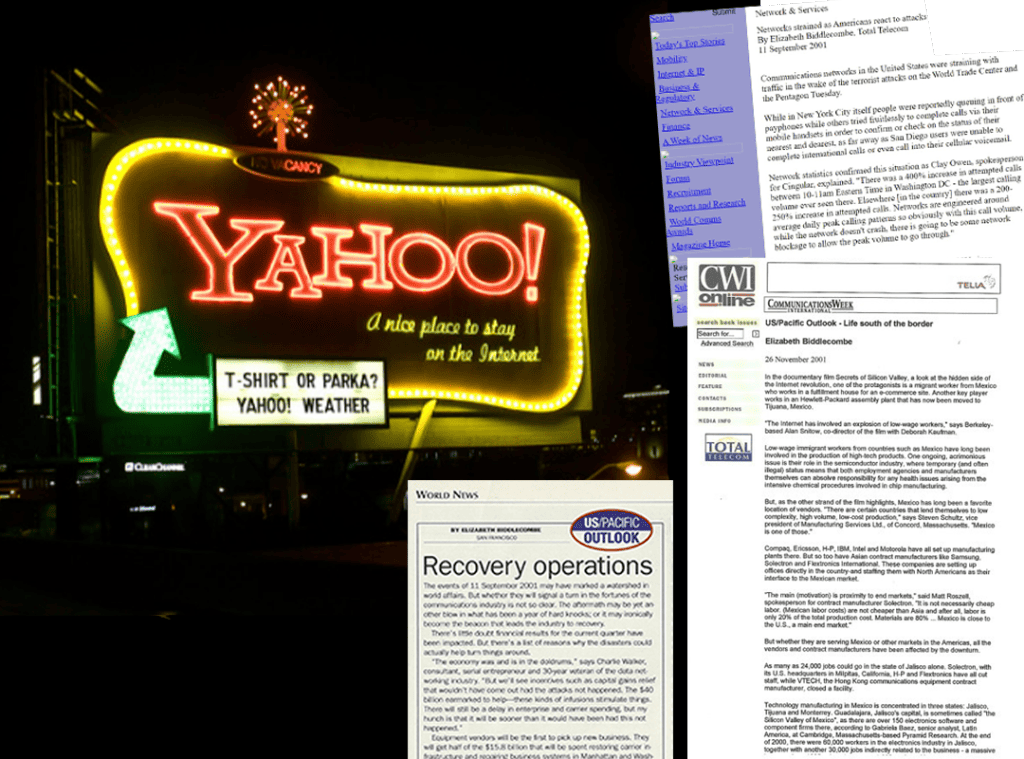
I arrived just as California was reeling from recent electricity blackouts and the dot-com stock market crash. Almost as soon as I had driven into town past the famous Yahoo neon sign, I was startled to see how visible people’s use of electronics was: In the London I had left, you wouldn’t see people using their (non-networked) laptops on public transport. In SF, you did. I was still using paper maps to navigate my new home.
Fixed internet connectivity to computing devices was widespread, but handheld computing devices such as the Palm Pilot, popular at the time, were not networked. Mobile phones were not as popular as they were in Europe and you couldn’t yet send a text message between different mobile network providers because mobile networks were a mix of network technologies like TDMA, AMPS and CDMA. I realised what an advantage we had in Europe by standardising on GSM.
Meanwhile, the fixed telephony side was confusing for a foreigner: when you picked up the phone, the provider you were connected to–the regional Baby Bell phone company–could only enable phone calls to the local area. While these calls were free, you had to get both a long-distance (and in my case, an international) provider if you wanted to call outside your area code.
I set about getting plugged in with local PR companies, got my headshot with the Golden Gate Bridge, learnt how to post stories online to the Total Telecom website–still a new idea at the time–and went to the major annual trade shows like CTIA and Supercomm.
It was at a trade show where I encountered a company called Boingo. They set me up with a free WiFi card–an external PC card at that stage–and an account. We didn’t have broadband or WiFi where I lived but network surfing had become increasingly popular. I used to go and sit outside the local launderette, piggybacking on someone else’s WiFi network to get online while I waited for my clothes. Not glamours but excitingly new.
The industry started talking about how WiFi would fit in and figuring out how anyone would make any money from it as it looked like it would be offered for free: one prediction that ended up being right.